
In over 16 years of working in digital marketing, I’ve seen businesses lose significant time and money not because social media doesn’t work — but because they chose the wrong agency.
Social media today is no longer about posting regularly. It’s about building predictable acquisition systems, reducing customer acquisition cost, and aligning content with revenue goals.
Choosing the right social media marketing agency is not a branding decision. It is a strategic growth decision.
And the difference between a posting agency and a performance-driven agency can determine whether your marketing becomes scalable — or stagnant.
If you haven’t read our foundational breakdown of how agencies drive structured growth, start with our complete guide to social media marketing agency strategy.
Let’s go deeper.
Why Most Businesses Choose the Wrong Agency
After 16+ years in digital marketing, I can confidently say this:
Most businesses don’t fail at social media because the channel doesn’t work.
They fail because they choose agencies based on surface indicators instead of performance infrastructure.
From experience, businesses often choose agencies based on:
- Price
- Promises of rapid growth
- Follower counts
- Attractive portfolios
- Personal referrals
While these factors matter, they rarely indicate performance capability.
Let’s break this down properly.
1. Choosing Based on Price Instead of Profitability
Price sensitivity is understandable. Marketing budgets must be justified.
But here is the reality:
A low monthly retainer tells you nothing about:
- Cost efficiency
- Customer acquisition cost
- Campaign profitability
- Long-term scalability
An agency charging less may simply:
- Avoid structured testing
- Skip advanced analytics
- Use templated strategies
- Limit paid media experimentation
- Reduce optimization frequency
In performance marketing, cost without context is meaningless.
A $1,500/month agency that produces zero qualified leads is expensive.
A $5,000/month agency that generates predictable revenue is affordable.
Businesses that anchor decisions purely on upfront cost often overlook downstream financial impact.
2. Falling for “Rapid Growth” Promises
“10K followers in 30 days.”
“Guaranteed viral content.”
“Explosive engagement.”
These phrases sound attractive — but they reveal a fundamental misunderstanding of how sustainable growth works.
Growth without qualification is noise.
Ask this:
- Are those followers buyers?
- Are they within your target geography?
- Are they decision-makers?
- Are they engaging meaningfully?
- Are they converting?
Rapid vanity growth often indicates:
- Paid follower tactics
- Broad, low-intent targeting
- Engagement bait strategies
- Short-term attention hacks
Sustainable growth is slower, structured, and data-informed.
Professional agencies focus on:
- Audience quality over quantity
- Intent over impressions
- Conversion over visibility
3. Being Impressed by Follower Counts
An agency’s own social media following does not automatically validate their client performance capability.
Some agencies excel at marketing themselves — but struggle to replicate structured ROI systems for clients in different industries.
High follower counts can be driven by:
- Trend-based content
- Industry commentary
- Personal branding
- Educational posts
None of these directly prove:
- Paid campaign profitability
- Lead generation systems
- Funnel architecture
- CRM integration
- Attribution modeling
The question isn’t:
“How many followers do they have?”
The real question is:
“How do they convert attention into revenue?”
4. Attractive Portfolios Without Performance Data
A visually stunning Instagram grid can be deceptive.
Design quality matters — but it is only one layer of the system.
Many agencies showcase:
- Beautiful creatives
- Modern UI mockups
- Polished brand feeds
- High-end video edits
What they don’t always show:
- Cost per lead trends
- Cost per acquisition
- ROAS benchmarks
- A/B test outcomes
- Funnel conversion rates
- Scaling case studies
Creative without performance is decoration.
In modern social media marketing, creative is a lever — not the strategy itself.
Strong agencies treat creative as a performance variable, constantly tested and optimized against data.
5. Choosing Based on Personal Referrals Alone
Referrals are valuable — but they must be contextualized.
An agency that worked brilliantly for:
- A local restaurant
- A B2C fashion brand
- A startup SaaS product
May not necessarily perform at the same level for:
- A B2B enterprise service
- A medical clinic
- A real estate development firm
- A manufacturing company
Every industry has different:
- Sales cycles
- Audience behavior
- Compliance constraints
- Customer acquisition cost structures
- Content dynamics
Blindly trusting referrals without evaluating strategic fit often leads to mismatched expectations.

What Actually Indicates a Strong Agency
The real indicators of a high-performance social media marketing agency lie beneath the surface — in systems, data frameworks, and revenue alignment.
Let’s define what that means.
1. System-Based Operations
Strong agencies operate on documented processes.
They have:
- Structured onboarding frameworks
- Defined audience research protocols
- Creative testing systems
- Weekly optimization cycles
- Monthly performance reviews
- Strategic scaling roadmaps
If you ask, “How do you work?” and the answer is vague — that’s a concern.
Professionals operate with repeatable systems.
2. Data Frameworks & Attribution Models
A high-level agency can clearly explain:
- How they track conversions
- How they assign attribution
- How they evaluate creative performance
- How they identify drop-off points
- How they measure engagement depth
They don’t just show metrics.
They interpret metrics.
They understand:
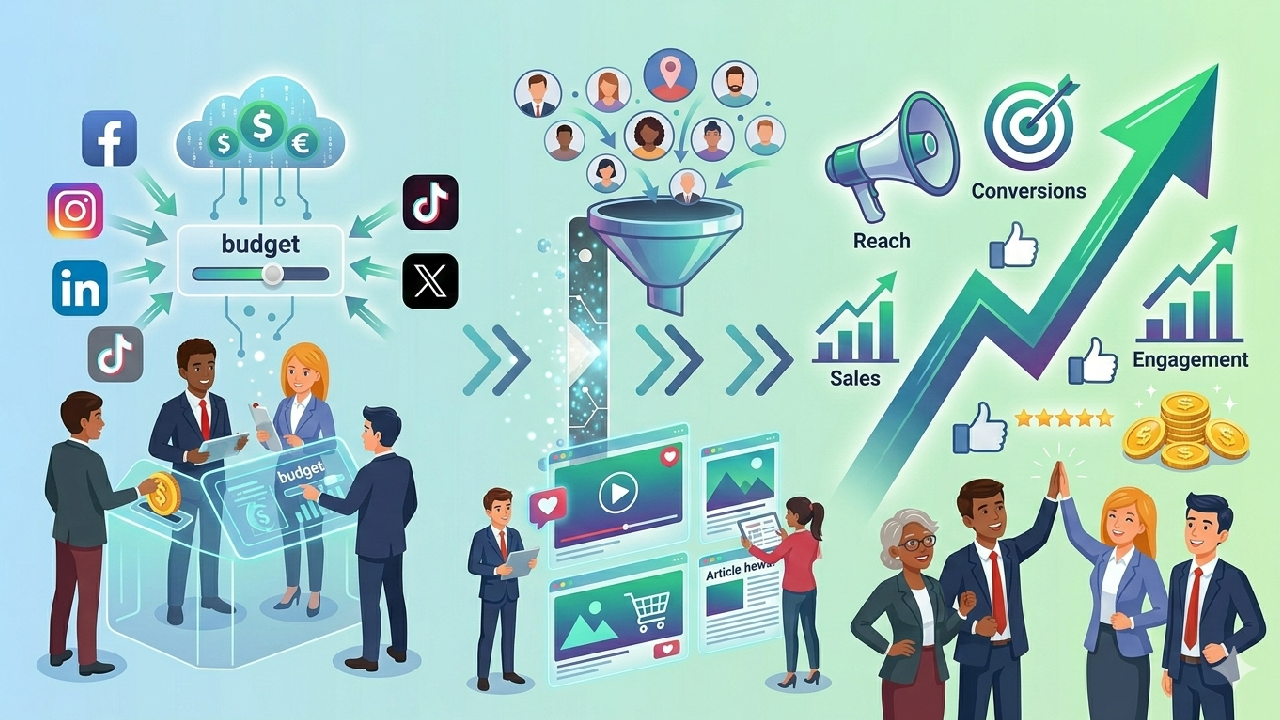
Cold audience → Warm audience → Hot prospect → Booked call → Closed deal.
Without attribution clarity, campaigns become guesswork with better graphics.
3. Revenue Alignment
The strongest agencies tie every activity back to business outcomes.
They ask:
- What is your target cost per acquisition?
- What is your customer lifetime value?
- What is your sales cycle length?
- What is your closing rate?
- What is your revenue target per quarter?
If an agency never asks about revenue — they are likely optimizing for engagement, not growth.
Marketing without revenue alignment becomes content production.
Marketing with revenue alignment becomes a growth engine.
4. Integrated Organic + Paid Strategy
Modern growth requires layered strategy:
- Organic authority building
- Paid acquisition
- Retargeting
- Funnel optimization
- Email nurturing
- CRM integration
Agencies that operate in silos — “we only do content” or “we only run ads” — often limit performance potential.
The strongest agencies think in ecosystems, not channels.
5. Continuous Optimization Culture
Marketing is not a one-time setup.
It is iterative.
Performance-driven agencies constantly:
- Test hooks
- Test messaging angles
- Test creatives
- Test targeting layers
- Analyze engagement quality
- Refine positioning
They operate with learning loops.
Without continuous optimization, campaigns plateau.
The Core Truth
Most businesses choose agencies based on what is visible.
The agencies that produce sustainable results are defined by what is invisible:
- Strategic depth
- Data interpretation
- Testing infrastructure
- Revenue alignment
- Long-term scalability
That is the difference between:
An agency that posts content.
And an agency that builds growth systems.
How to Evaluate a Social Media Marketing Agency Strategically
After understanding what separates surface-level indicators from real performance infrastructure, the next step is structured evaluation.
Choosing the right social media marketing agency is not about instinct — it’s about asking the right strategic questions.
Below is the exact framework I recommend after 16+ years of working with growth-stage and scaling brands.
Use this as your decision-making checklist.
Step 1: Understand What You Actually Need
Before evaluating any agency, you must define your objective.
Are you looking for:
- Brand awareness?
- Lead generation?
- E-commerce conversions?
- Market expansion?
- Authority positioning?
A professional social media marketing agency will ask these questions before proposing a solution.
If the first conversation revolves around “How many posts per week?” — that’s a red flag.
Posting frequency is a tactic. Growth is the objective.
Step 2: Evaluate Their Strategic Framework
Every serious agency operates with a documented framework.
Ask:
- How do you structure campaigns?
- How do you align social media with sales funnels?
- How do you track attribution?
- What metrics define success?
Look for answers involving:
- Funnel mapping
- Audience segmentation
- Retargeting layers
- Paid social media advertising integration
- Conversion tracking
If strategy is vague, performance will be inconsistent.
Step 3: Demand Transparency in Reporting
In my experience, transparency is where many agencies fall short.
You should receive reports that clearly outline:
- Ad spend
- Cost per lead
- Cost per acquisition
- Return on ad spend
- Conversion rates
Vanity metrics like reach and impressions have their place — but they should not dominate reporting.
Professional social media management focuses on business impact.
Step 4: Review Case Studies, Not Just Creative
A beautiful Instagram grid does not equal performance.
Ask for:
- Before-and-after performance data
- Cost reduction improvements
- Revenue impact
- Funnel performance improvements
- Scaling case examples
An agency confident in its work will share measurable results.
If all you see are visuals without numbers, proceed cautiously.
Step 5: Assess Paid Social Media Advertising Capability
Organic growth alone is rarely sufficient in competitive markets.
Your agency must demonstrate expertise in:
- Meta Ads (Facebook & Instagram)
- LinkedIn advertising
- Retargeting campaigns
- Lookalike audience modeling
- Creative split testing
Strong paid social media advertising is what transforms content into scalable growth.
Agencies that rely only on organic posting limit your expansion potential.
Step 6: Understand Their Learning & Optimization Process
This is where advanced agencies stand apart.
Ask:
- How do you test creatives?
- How often do you optimize campaigns?
- How do you apply learnings across accounts?
- Do you operate with structured debrief systems?
Marketing should be iterative, not static.
If there is no feedback loop, there is no compounding improvement.
Step 7: Evaluate Communication & Alignment
Over 16 years, I’ve learned this clearly:
Even the best strategy fails without communication.
You need:
- Clear points of contact
- Defined response times
- Strategy calls
- Monthly performance reviews
- Alignment with internal teams
An agency should feel like a growth partner — not a vendor.
Step 8: Beware of These Red Flags
Here are warning signs to watch for:
❌ Guaranteed follower growth promises
❌ “Viral” guarantees
❌ No discussion of customer acquisition cost
❌ No conversion tracking setup
❌ No paid advertising strategy
❌ Focus only on content volume
Serious agencies talk about revenue, retention, and scalability.
Step 9: Consider Long-Term Scalability
Choosing an agency is not about short-term campaigns.
Ask yourself:
- Can they scale ad spend from $2,000 to $20,000?
- Can they expand into new markets?
- Can they manage multi-platform ecosystems?
- Do they integrate with CRM systems?
Scalability determines whether your marketing matures over time.
The Cost Perspective: Cheap vs Strategic
Low-cost agencies often:
- Reuse templates
- Avoid deep analytics
- Skip structured testing
- Provide generic strategies
High-quality agencies:
- Invest in data
- Prioritize ROI
- Continuously optimize
- Align with business goals
The difference is not cost — it is long-term profitability.
If you’d like a deeper breakdown of pricing models and structures, see our guide on social media marketing agency pricing.
The Importance of Industry Experience
Experience brings:
- Pattern recognition
- Faster diagnosis of performance issues
- Stronger strategic clarity
- Better crisis management
Agencies with cross-industry exposure can adapt faster.
Sixteen years in this field has shown me that algorithm changes, platform shifts, and consumer behavior patterns evolve — but strategic fundamentals remain.
Choose experience over experimentation.
AI, Data & Modern Agency Capabilities
Today’s best agencies integrate:
- AI-driven analytics
- Predictive keyword research
- Performance forecasting
- Advanced attribution models
If your agency isn’t leveraging data intelligence tools, you may be falling behind competitors who are.
AI does not replace strategy — it enhances it.
Questions to Ask Before Signing
Use this checklist:
- How do you measure ROI?
- What attribution model do you use?
- How do you structure paid + organic integration?
- How often do you optimize campaigns?
- Can you share performance-based case studies?
- What does onboarding look like?
- How do you scale successful campaigns?
The answers will tell you everything.
Frequently Asked Questions (FAQs)
What does a social media marketing agency do?
A social media marketing agency develops and manages strategies across platforms like Facebook, Instagram, LinkedIn, and TikTok to generate brand awareness, leads, and revenue. Services typically include social media management, paid social media advertising, content strategy, audience targeting, and performance tracking.
How do I choose the right social media marketing agency?
Choose an agency based on strategic framework, data transparency, paid advertising capability, case studies, and revenue alignment — not just price or follower counts. A strong agency focuses on ROI, attribution, and scalable growth systems.
How much do social media marketing services cost?
Social media marketing services can range from $1,000 to $10,000+ per month depending on scope, ad spend, platforms managed, and performance objectives. Pricing should align with expected ROI and growth goals rather than content volume alone.
Is paid social media advertising necessary?
In competitive markets, paid social media advertising is essential for scalable growth. Organic content builds authority, while paid campaigns drive targeted traffic, lead generation, and measurable conversions.
What is the difference between social media management and social media marketing?
Social media management focuses on posting, engagement, and content scheduling. Social media marketing includes strategy, paid advertising, conversion tracking, funnel optimization, and revenue alignment.
How long does it take to see results from a social media marketing agency?
Most businesses begin seeing measurable performance data within 60–90 days. Sustainable growth and optimized ROI typically develop over 3–6 months of continuous testing and optimization.
Should small businesses hire a social media marketing agency?
Yes, if the goal is structured growth and professional execution. Agencies provide strategic planning, creative testing, paid campaign management, and performance tracking that most small businesses cannot execute internally at scale.
What metrics should a social media agency report?
A professional agency should report cost per lead, cost per acquisition, conversion rate, return on ad spend (ROAS), engagement quality, and funnel progression — not just impressions and likes.
Can social media marketing generate qualified leads?
Yes. When structured properly with audience targeting, retargeting layers, and funnel alignment, social media marketing can generate high-quality, conversion-ready leads consistently.
What red flags should I avoid when hiring an agency?
Avoid agencies that guarantee viral growth, focus only on followers, lack conversion tracking, avoid discussing ROI, or cannot provide performance-based case studies.
Final Thoughts
Choosing the right social media marketing agency is one of the most critical growth decisions your business will make.
Social media today is not optional.
Paid amplification is not optional.
Data-driven optimization is not optional.
The right agency transforms social platforms into predictable revenue engines.
The wrong agency turns them into expensive content calendars.
If you’re serious about building scalable systems, revisit our comprehensive social media marketing agency guide to understand the full strategic framework behind sustainable growth.